Summary Document: 4 page PDF Leadership & Care
Clarifying Responsibilities in Our Minds
Now we begin the logic Leadership and Care provides for addressing troubling behavior by making it clear who has responsibility for dealing with mistakes. For example, some parents and teachers can be very strict and assume full responsibility for dealing with any violation; others can be very open to children working things out by themselves. As long as those conditions are clear and adhered to consistently — so they become shared expectations, a norm for conduct — children can be fine. The problem comes when the expectations are not clear or are inconsistent. I see mushiness about responsibility all the time in classrooms with problems.
The video below shows a group of student teachers in my laboratory preschool who do not share a common determination of responsibility, so you can see what happens when responsibility is that mushy. Yes, this clean-up time was chaotic, but that was how the laboratory worked. My role as the instructor in this early childhood education program was to set up the school, videotape what happens, an enable the participants to work together to co-construct an understanding of what was going on, reflect upon it, and plan for future correction. That is how this group of educators came to understand the need to Clarify Responsibilities: they saw it, they corrected it, and got their money’s worth in learning.
The video marks 9 problems in these four minutes of tape. The challenge is to decide for each numbered action who has responsibility.
I invite you to try coding each event with A, B, or C.
A — ADULT — The adult has responsibility to put a stop to this behavior for essential reasons.
B — CHILD — The adult does not stop this behavior because it is the responsibility of the children to work together to solve this problem; the adult remains near to lightly assist if necessary.
C — IGNORE — The adult lets it slide without calling attention to it.
- takes paper tube
- strikes with tube
- grabs red telephone
- sword play
- running in circles
- wrestling
- sitting on cabinet
- pokes finger in eye
- tummy bumping
You may write the numbers 1-9 on a paper and decide A, B, or C.
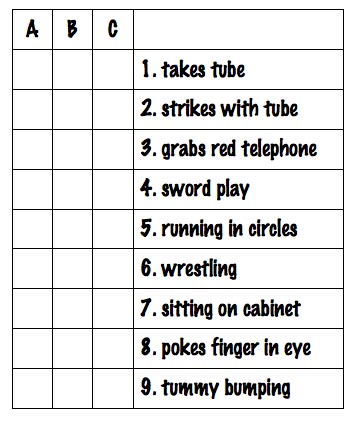
I invite you to share your judgments with others to see if you agree upon these responsibility distinctions. There is no right answer here. What is essential is that the leadership team agree, so the children can understand the expectations.
Discoveries
The students discovered after watching that video how all of them responded to a range of behaviors in similar ways, despite the realization that the locus of responsibility varied in each case. Not all the behaviors were the same, so they faced the problem of differentiating which were the adult responsibility and which were the children’s responsibility.
If we agree that we wish to create open spaces for growth and possibility, it is essential to share power with the children; only then can they learn to act in equally caring and empathic ways. That is not accomplished by being coercive of children nor obedience by children. Our leadership of a caring community of children starts with common agreement about responsibility among educators at school (and common agreement between parents at home), so children can take on developing ways of caring for each other, themselves, and the community.
For me, #8. pokes finger in eye is the only instance that seems to me to require adult action, so I rate it as an A. Since I take responsibility for safety, I take it on and put a stop to it. The rest are B or C. Again, I don’t wish to imply one ‘right’ answer here. Whatever is agreed upon by adults becomes the current base for action. Agreement is the key, and that agreement can evolve over time.
What I would do next, of course, depends upon the situation and my relationship with the child who made the mistake. I do know that poking a finger in someone’s eye is non-negotiable and that I must take action. As you might have noticed in the video, the poking child in the stripes pulls again and again on that oops finger. I would bet he recognized the mistake, too. I would approach him with firm authority while supporting the possibility of his current regret in mind. On the Assertive page we examine ways to take action. I can be flexible in what I choose to do depending on the circumstances and people involved, but I take direction action to convey my concern and my responsibility for ensuring the health and safety of everyone.
I Don’t Like it When…
It’s Not OK to…
Neither of these common ways to talk clarifies anything. People use them, I think, because the have either heard others or have been told to say it this way. Both are not authentic, straight-forward communication.
So you don’t like it. So what? The child has no responsibility over how you feel or don’t feel. The child does not control your emotions. Get over it.
It’s not OK. Who is making the determination of approval or disapproval. Who is “it?” Where is this vague source? Is there a list somewhere of what is OK and what is not OK? What does OK mean?
You can see that neither formulation clarifies responsibility, so let’s talk straight. Let’s set up the structure for responsibility in a way that provides opportunity for discussion about alternative ways to meet our desired goals. We approach structure through two kinds of rules.
Not Negotiable Rules and Negotiable Agreements
Not Negotiable (my responsibility as authority)
Agreements (our responsibility as opportunity)
These are distinctly different ways to provide structure and require distinctly different language. The literature presents many ways to  talk about rules or guidelines for expectations, but I have chosen to follow the language of Jean Illsley-Clark and Connie Dawson in Growing Up Again. Parents who are reading that book can more readily understand how to phrase rule making if the language is the same at school and at home. The classroom becomes a model ways to communicate responsibilities and consistent structure. We talk about what is not negotiable and what can be negotiated together.
NON-NEGOTIABLE RULES
We show that we are the manager who is firmly taking responsibility. We acts with authority to block prohibited, dangerous or excluded actions.
Non-negotiable rules are usually stated as prohibitions, like these:
- No hurting or endangering anyone.
- No destruction (usually non-disposable materials and equipment).
- No put downs (critical or degrading remarks about others).
- No out of bounds (specified limited areas).
AGREEMENTS
We describe the goals or ideals to we would like and open a dialogue with children about how to get there. The goal is to lead children in a gathering time to consider how they might act to achieve that possibility. An agreement, of course, means we also participate in that discussion about the means. We seek clarity. We are take charge of this agenda: today we are discussing ideas and creating ways where all parties can agree on a particular course of action. The agreements are always modifiable if they end up not working. The adult, of course, must agree, too. Agreements become guides for solving problems as they arise in a harmonious way.
To bring up a discussion about agreements we phrase the ideals we are striving for, like these:
- We use words to solve problems.
- We care for others’ work, body, and space.
- We open to all the right to be included.
These statements of ideals are followed by an invitation to figure out how to solve the current problem in a way that accomplishes that end. How do you think we can do that here?
The bullets above are phrasings that I have found to work pretty well for those situations. The goal sets the expectations we all hold in mind as we live through unforeseen change contexts and events.
For example, the adults may prohibit a child from running around with food in their mouth. When a rule is non-negotiable the adult has placed it in their responsibility basket and takes on the responsibility for watchful enforcement.

With an agreement, the children have primary responsibility; they help each other fix their mistakes. Mistakes become valuable opportunities for cooperative corrections. Mistakes must occur in order for the children to learn to manage them.
The hard part of facilitating agreements is at the start. Often the children have not done this before, and most adults have never experienced being included in making decisions. Opening that dialogue clearly is something that must be studied.